

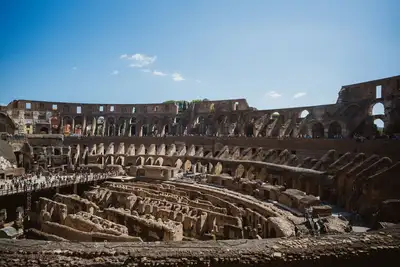
There's a kind of exhaustion that hits you at baggage claim in Rome after a 14-hour journey from Los Angeles, knowing you have exactly 36 hours before your flight to Prague. You've paid a small fortune for the privilege of standing under fluorescent lights at Fiumicino, watching a carousel that hasn't moved in six minutes, trying to remember whether the Colosseum is walkable from your hotel or whether you'll need to burn another twenty euros on a taxi.
This is modern luxury travel. This is what we're supposed to want.
The travel industry has spent decades convincing people that speed equals status. That a passport stuffed with stamps is proof of a life well-lived. That seven countries in ten days isn't a symptom of anxiety, it's an achievement. The influencer standing on a rooftop in Santorini at sunrise before catching a noon flight to Mykonos isn't consuming Greece in any meaningful way, she's consuming it, and the distinction matters enormously.
I've done it. Most of us have. And it's not travel, it's logistics with a view.
The Commodification Problem
When a place becomes a checkbox, something ugly happens. The destination stops being a living community and becomes a product designed for your consumption and departure. Tour operators know this, and they've built entire empires around it. A luxury "whistle-stop" itinerary through Tuscany in 2023 averaged between $800 and $1,400 per person per day, and what did travelers get for that? Lunches at agriturismo farms that exist primarily to host lunches. Wine tastings with English-speaking sommeliers who've given the same speech about "terroir" four hundred times this season. A coach that picks you up at 8 AM and deposits you elsewhere at 5 PM, having seen everything and touched nothing.
The places suffer too. Venice has been screaming about this for years. The city's resident population dropped below 50,000 in 2021 for the first time in recorded history, while tourist numbers before the pandemic were hitting 25 million annually. The math is brutal. When a destination becomes optimized for rapid tourist throughput, it hollows out. Rents spike. Locals leave. The bakery that made bread for the neighborhood becomes a place that sells bread-shaped souvenirs to people who have forty-five minutes in the piazza before the boat leaves.
Speed does this. The faster you move through a place, the more you're part of the problem.
What Slow Travel Actually Is
It isn't about going somewhere and staying longer, though that's part of it. Slow travel is a refusal. It's a refusal to treat a place as a backdrop, to treat local people as service workers in your personal adventure film, to treat your own time as needing efficient maximization.
In practice, it often looks like this: you go somewhere, you find cheap lodging for at least two weeks, and you figure out the rhythm of the place by being inside it. You shop at the market where residents shop. You learn the bus routes because you have to, not because a tour operator planned them for you. You eat at the place around the corner that has no English menu and terrible lighting and the best chickpea soup you've ever had in your life.
I spent six weeks in Oaxaca City in the spring of 2019 on a budget that worked out to roughly $35 a day including accommodation. By week three, I knew which tortillería on Calle Mina opened at 6 AM and which one was worth the extra fifteen-minute walk on Saturdays. I knew that the market at Mercado Benito Juárez got its best produce deliveries on Tuesday and Thursday mornings. I had a regular table at a comedor where the owner, a woman named Guadalupe, started keeping a pot of black beans on the back burner because she knew I'd be there. None of that was in a guidebook. None of it could be, because it emerged from presence, from being in one place long enough that the place started to recognize you back.
That's the thing nobody tells you. Stay long enough and a place starts to meet you halfway.
The Budget Paradox
Here's what the travel industry doesn't want you to understand: slow travel is almost always cheaper. Significantly cheaper. The per-night cost of accommodation drops dramatically when you're not paying the tourist premium for flexibility. A hostel private room or a cheap apartment rental in Bologna, Italy runs between €40 and €70 a night when you commit to two weeks or more. The equivalent "luxury" hotel for a two-night stop costs €180 per night minimum, and that's before you've paid the premium markup that every single restaurant and shop charges in tourist-heavy zones.
Transport is the other big one. Budget airlines have made hopping between European cities seductively easy, but the true cost of a €29 Ryanair flight from Barcelona to Lisbon is never €29. It's the €15 bag fee, the €25 taxi to the out-of-town airport, the €12 coffee and sandwich you bought in the terminal because you were there two hours early, and the €40 cab on the other end because you landed at midnight and the metro had stopped running. You've just paid €121 to travel in a metal tube for two hours and arrive disoriented.
The train from Barcelona to Lisbon, booked a few weeks out, runs around €60-80 on a good day. It takes longer. It also passes through some of the most beautiful terrain in Iberia, the cork forests of Extremadura, the plains outside Mérida, the slow approach into Portugal along the Tagus. And you arrive in the city center, not at an airport in a suburb nobody has heard of.
Slow down. Spend less. See more.
On the Pleasure of Getting It Wrong
The best travel story I own happened because I misread a bus schedule in rural Umbria in October 2017. I was trying to get from Spoleto to a small hill town called Norcia, a town famous for its cured meats and its truffle market and for being almost completely destroyed by an earthquake the previous year. The bus I thought was going to Norcia was actually going to Cascia, which is a different hill town entirely, forty minutes in the wrong direction.
I could have panicked. I had no plan in Cascia, no booking, no idea what was there. What was there, as it turned out, was a basilica dedicated to Saint Rita that draws Italian pilgrims by the thousands, a tiny pension run by an elderly couple who charged me €35 for a room and breakfast, and a Thursday evening passeggiata that felt completely untouched by anything resembling a tourist industry. I stayed two nights. I never made it to Norcia.
Could that have happened on a curated itinerary? Not a chance. The whole architecture of rapid luxury travel is designed to eliminate exactly the kind of productive failure that leads to Cascia. Everything is pre-booked, pre-confirmed, pre-experienced. The itinerary exists to prevent surprise, and in doing so, it prevents discovery.
What are you paying for when you pay to eliminate the unexpected?
The Foot Problem
There's something that happens when you walk. Not when you take a Segway tour or an e-bike through the old town, but when you walk, slowly, without a destination, for two or three hours at a time. Your brain shifts. The scale of a place becomes tangible in a way that no amount of reading or watching or riding can replicate.
I walked across a significant chunk of the Camino Francés in 2022, from Saint-Jean-Pied-de-Port to Burgos, roughly 280 kilometers over eighteen days. The point wasn't pilgrimage. The point was to move through a landscape at human speed and see what that speed revealed. What it revealed was extraordinary and completely ordinary at the same time: the way the light changed over the Meseta at 7 AM, the agricultural villages that appear at the precise moment your legs are giving out, the rhythm that emerges after about a week when your body has accepted the situation and stops complaining.
You can't buy that. You can buy a luxury tour of Santiago de Compostela that includes a blessing at the cathedral and a tasting menu and a private driver. But you can't buy the version where you've earned the cathedral with your feet, where the distance between where you started and where you ended is a physical fact stored in your muscles.
Slow travel at its most extreme is walking. And walking is free.
Local Transport as Cultural Curriculum
The local bus system in any city is basically a graduate seminar in how that place functions. Who rides the bus? Where are they going? What do they carry with them? What do they talk about, even if you can only approximate the words?
I took the number 9 bus in Istanbul from Eminönü out to Fatih on a Tuesday morning in November 2018, mostly because I was trying to get and had no idea what I was doing. The bus was packed with women returning from the morning market with canvas bags full of vegetables and bread. A man was transporting a large and extremely unhappy rooster in a cardboard box. An elderly woman tried to explain to me at length in Turkish, and while I understood approximately none of it, I gathered from her gestures that I was sitting in the wrong seat and should move two rows back, which I did.
None of this is in the Lonely Planet. None of it should be. The whole point is that it belongs to the place, and you get access to it only by being willing to be confused, to be wrong, to be a person rather than a tourist.
The business class seat to Istanbul, the private car to the hotel, the hamam with English-speaking attendants... all of it creates a membrane between you and the actual city. The membrane is expensive. And it's keeping you out.
The Philosophy of Enough
Slow travel requires confronting a question that luxury travel is specifically designed to help you avoid: how much is enough?
The jet-set model is built on scarcity anxiety. There's always another destination, always a new opening of boutique property in previously undiscovered location (and honestly, the word "undiscovered" is doing enormous amounts of dishonest work in those press releases). The implication is that you need to keep moving, keep consuming, keep accumulating before they're ruined or before someone else gets there first.
Slow travel says: this is enough. This street, this morning, this light on this building is enough. Sitting in a square in Girona on a Wednesday afternoon watching pigeons and old men play cards is enough. It doesn't need to be combined with three other cities to justify the plane ticket.
This is difficult for people trained by a culture of optimization. The fear of missing out is neurological, it's been deliberately cultivated by an industry that profits from your restlessness. But the antidote to it isn't more travel. The antidote is depth.
A Practical Word on Making It Work
The most common objection is time. "I only have two weeks of vacation. I can't spend it all in one place."
You can, though. And two weeks in one city, properly done, will leave you with more than two weeks spread across six cities. Go to Seville for fourteen days. Stay in the Triana neighborhood, across the river from the tourist center. Shop at the Mercado de Triana on Thursday mornings. Walk to Parque de María Luisa in the late afternoon when the light is doing what Seville light does. Take the local bus out to Italica on a Tuesday, the old Roman city that most tourists skip entirely because it isn't on the efficient itinerary. Learn five words of Spanish a day. By day ten, you'll have fifty words and the beginnings of belonging.
What's the alternative? Two days in Seville, two in Granada, two in Madrid, two in Barcelona, and a night on either end for travel. You'll have seen the Alhambra through the window of a tour group and eaten paella at a restaurant that exists to serve people who have forty-five minutes and don't know any better.
Not even close.
What You're Actually Buying
Every travel decision is a choice about what kind of experience you think you deserve. The luxury rapid-itinerary model says you deserve comfort, efficiency, and the sensation of having done a place. It says your time is too valuable to waste on wrong buses and confusing schedules and meals that might not be very good.
But that framing is exactly backwards. The wrong bus and the confusing schedule and the meal that turns out to be extraordinary or terrible or both... that's the travel. The rest of it, the smooth transfers and the pre-booked restaurants and the private guides who keep everything on track, is expensive transportation between photo opportunities.
Places are inconvenient. Culture resists the itinerary. People have their own schedules and concerns and aren't particularly interested in being a feature of your vacation, and the only way to move past that, to get to something genuine, is to stay long enough that you stop being a tourist in their eyes and start being, at minimum, a familiar inconvenience.
Slow travel is the practice of becoming a familiar inconvenience. It's cheaper, richer, and more honest than anything the luxury travel industry is selling.
Worth it. Every single time.

Comments (0)
No comments yet. Be the first!