

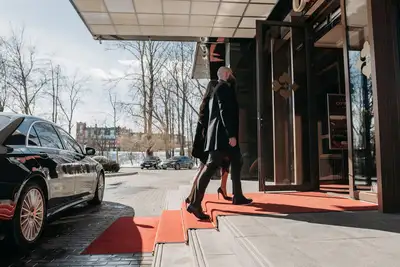
There's a famous hotel in Rome (I won't name it, they don't need the attention) where guests are shielded so thoroughly from the actual city that they might as well be watching a documentary about it. Climate-controlled shuttles. Pre-arranged everything. Staff trained to anticipate needs before they're felt. It costs more per night than most Italians earn in a month. And the guests, by all accounts, love it.
Which raises the question: what exactly did they come for?
If the goal was to feel exactly as you feel at home, with better weather and a view of the Colosseum through tinted glass... you've succeeded, I suppose. But you haven't traveled. You've relocated your comfort zone by about 6,000 miles. That's not the same thing.
The Industry Built a Machine for Avoiding Reality
The modern luxury travel industry runs on a single, powerful promise: we will protect you from the unexpected. From the inconvenient. From the confusing, the messy, the uncomfortable, the foreign. Every product in the upper tier of travel, every "seamless transfer" and "pillow menu" and "personal concierge available 24/7", exists to eliminate friction.
And friction, it turns out, is where all the interesting stuff happens.
This isn't just an aesthetic complaint. There's a psychological mechanism at work here. When you're comfortable, your brain conserves energy. It doesn't need to problem-solve. It doesn't need to adapt. The neurological state you enter when you're lost in a city you don't know, trying to communicate in a language you barely speak, figuring out a bus system through trial and error... that state is the opposite of comfort. And it's also the state in which you're most alert, most present, most alive to what's around you.
The Center for Responsible Travel has documented how "tourist bubble" infrastructure (the web of high-end hotels, private transfers, and pre-packaged experiences) isolates visitors from host communities. The bubble keeps you in, and it keeps the actual place out. You pay more for less contact with what's there. The industry calls this "premium." I'd call it something else.

A Cafeteria in Reggio Calabria
I think about this a lot when I remember a story from a friend who first went to Italy decades ago. He flew into Reggio Calabria with expectations shaped entirely by tourist brochures: grand hotels, famous restaurants, the whole script. His first night, he stayed in an Excelsior hotel that was, by his own admission, a hotel. Ate at a famous restaurant that was, by his own admission, a restaurant. Forgettable. Expensive. Correct.
The next day he walked out of the airport, got lost, walked miles, and ended up eating underwhelming food in a cafeteria. He remembers every detail of it. The smells, the views, the laughter, the strangeness of it. He's told that story hundreds of times. The hotel? He barely recalls it existed.
That asymmetry says everything.
The cafeteria was uncomfortable. Confusing. Probably a little embarrassing. And it lodged itself permanently in his memory because it required him to be there, fully present, without a buffer. The hotel asked nothing of him. So it gave him nothing in return.
Historical Wanderers Knew This Intuitively
This isn't a new insight. The travelers we actually remember, the ones whose accounts we still read, were rarely the ones staying in the best rooms.
Isabelle Eberhardt, the Swiss-Algerian writer, spent the 1890s and early 1900s traveling through North Africa dressed as an Arab man, sleeping rough, learning Arabic, getting into trouble. Her writing crackles with actual contact with the world. She wasn't protected from Algeria. She was inside it.
Or consider Bruce Chatwin, whose accounts of Patagonia in the late 1970s are still worth reading precisely because he wasn't insulated from the place. He stayed in strange houses with strange people. He got things wrong. He was confused and sometimes cold and occasionally in actual physical difficulty. His book about it remains one of the most alive pieces of travel writing in the English language.
These people weren't masochists. They weren't seeking discomfort for its own sake. But they understood (intuitively, if not explicitly) that the gap between your expectations and reality is where you actually learn. About the place. About yourself.
What Comfort Actually Costs You
There's an irony buried in the luxury travel proposition that I don't think gets examined enough. The argument for spending more on travel is usually framed as getting more: more quality, more access, more. But in a very specific and important sense, you're getting less.
You're getting less uncertainty. Less improvisation. Less authentic encounter. Less of the thing that changes people.
Research on transformative experience, and this field remains contested and still developing, suggests that growth, psychological and otherwise, happens at the edge of competence. When things are slightly too hard. When you're outside your comfort zone. When the situation requires more of you than you were expecting to give.
Luxury travel is specifically designed to prevent this. The "edge of competence" is smoothed away. Problems are anticipated and pre-solved. You never have to figure anything out because someone already figured it out for you. And you come home with great photos and a tan and, I'd argue, roughly the same person you were when you left.
That's not a judgment. It's what it is.
The Minimalist Travelers Are Onto Something
There's a growing movement (still marginal, still mostly ignored by mainstream travel media) of travelers who are deliberately choosing less. Slower, smaller, harder. A week in one village instead of seven cities in ten days. One bag that fits in an overhead bin. No car, so you have to figure out the bus. No translation app, so you have to actually try to communicate.
This isn't poverty tourism or performative suffering. It's a considered choice to remove the buffers that prevent real contact.
The practical results are often remarkable. When you don't have a private transfer, you end up sharing a bus with the people who actually live there. When you don't have a hotel concierge, you end up asking a stranger for directions and somehow, inexplicably, being invited to something. When your accommodation is basic, you spend more time outside it, in the actual place.
Some operators are starting to work from this philosophy. Another model exists: Culture Discovery Vacations has built its approach around the idea that genuine encounter matters more than comfort management: that the goal of a trip to Italy, say, isn't to observe Italy at a remove but to actually touch it, including the parts that are confusing or inconvenient or don't match the brochure.
That's a harder sell than a pillow menu. But it's an honest one.
The Discomfort Gradient
This argument can slide quickly into sanctimony if you're not watching it. The point isn't that suffering is virtuous. It's that friction is generative, and that there's a meaningful difference between discomfort that teaches you and discomfort that's unpleasant.
Getting food poisoning from bad shellfish is not enlightening. Being cold because you didn't pack correctly is annoying. Physical danger, obviously, serves no one.
But there's a wide band of experiences between "perfectly comfortable" and "miserable" where most of the interesting travel happens. Getting lost and having to ask for help. Arriving without a plan and having to improvise. Eating unfamiliar food because it's what's on offer. Sitting with the discomfort of not understanding what's happening around you.
Call it the discomfort gradient. And the luxury industry's entire proposition is to keep you at the comfortable end of it, always. Even when you're in Marrakech or Oaxaca or Dubrovnik: places that are interesting precisely because they're not like wherever you came from.
What Actually Changes People
I've thought about this for a long time, and I keep coming back to the same observation: the travel stories people tell over and over, the ones that become part of who they are, are almost never about the things that went smoothly.
Nobody tells the story of the hotel where everything was perfect. They tell the story of the overnight train that was delayed for six hours and they ended up talking to a retired schoolteacher from Thessaloniki until 3am. They tell the story of getting lost in the medina in Fez and eventually being led out by a kid who refused any money for it. They tell the story of the meal that looked alarming and turned out to be the best thing they'd ever eaten.
These stories have a structure. There's a moment of friction or uncertainty or mild crisis. Then there's the improvisation, the contact, the unexpected resolution. The friction is the door. Everything interesting is on the other side of it.
Luxury travel seals the door shut. It's very good at sealing the door shut. And it charges you a premium for the sealing.
The Question Nobody in the Industry Wants to Ask
If comfort is the enemy of growth, and the entire premium tier of travel is selling comfort... what is the premium tier actually selling?
Status, partly. The ability to say you stayed somewhere expensive, which signals to certain people. Instagram content, partly. The pool, the view, the aesthetic. A kind of safety, perhaps, the sense that nothing can go wrong, that you're protected from the unpredictability of the world.
None of these are illegitimate desires. But none of them are reasons to travel. They're reasons to perform travel, which is a different activity with different outcomes.
The travel industry conflates these constantly, deliberately. The language of "experience" and "discovery" and "adventure" is deployed to sell products specifically designed to prevent the conditions under which genuine discovery happens. It's a neat trick. It works because most travelers don't examine the contradiction closely enough.
What Raw Travel Actually Asks of You
There's a reason not everyone wants this. Raw travel (travel without the buffers, without the pre-solved problems, with genuine uncertainty built in) asks of you what comfort travel doesn't. It asks you to be present. To be flexible. To be okay with not knowing what's going to happen next.
For a lot of people, that sounds like anxiety, not vacation. And I get that. The world is stressful enough without deliberately adding uncertainty to the two weeks you get off work each year.
But I'd push back gently on the assumption that discomfort and relaxation are opposites. Some of the most restful travel I've encountered is slow and simple and uncertain. A rented room above a family's house in Umbria. Meals that depend on what the market had that morning. Days with no agenda. The relaxation there isn't the absence of friction; it's the presence of what's real.
That's harder to manufacture. Harder to package. Harder to sell at a premium. And that's exactly why the industry doesn't try.
The Return
Here's the thing about comfort travel: you come home the same person. Rested, maybe. Photographed, definitely. But essentially unchanged. The world didn't ask anything of you, so you had nothing to give, and nothing was given in return.
Raw travel (the kind with friction, with uncertainty, with actual contact) does work. You come home with the rough edges of your assumptions worn down a little. You've been reminded that there are a thousand ways to organize a life, and most of them don't look like yours. You've had to rely on strangers and found them, more often than not, reliable. You've been confused and figured it out. You've been wrong about something and adjusted.
These aren't dramatic revelations. But they accumulate. They change the shape of how you see things, slowly, over time.
The hotel that erases every friction also erases every chance you have to discover what you're actually made of. That's not a coincidence. It's the product.
The question is whether you want to keep buying it.
Edited by the Anti-Luxury Travel editorial team.

Comments (0)
No comments yet. Be the first!